

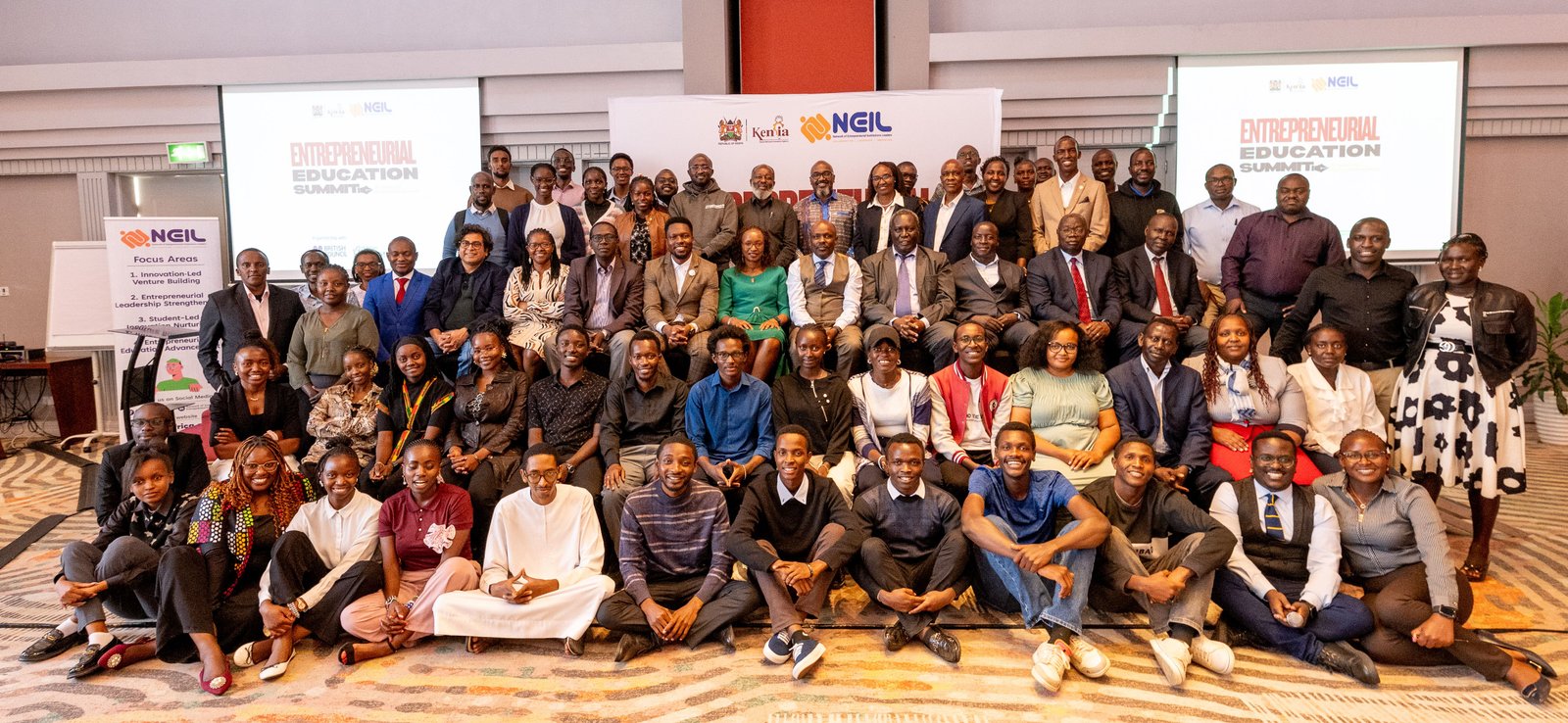
Nobody saw it coming. On the 30th of January 2026, Kenya’s universities collectively decided that maybe—just maybe—churning out only certificate-wielding graduates isn't the winning strategy for national prosperity. The revelation came during a one-of-a-kind gathering: the Entrepreneurial Education Summit. The summit brought together more than 200 university leaders, government officials, university students, and industry leaders who sat in a room and did the unthinkable. They agreed.
Not Just Certifcates holders, let's have Problem Solvers
Prof. Shaukat Abdulrazak, the Public Secretary (PS) for the State Department of Science Research and Innovation, opened with a professional roast of the entire status quo. "The future of Kenya will not be built by certificates alone," he declared. "It will be built by entrepreneurial minds, ideas, and ventures."
Translation: That framed degree on your wall? It's a nice decoration. But can you actually build something impactful in society?
The sentiment was echoed by Dr. Tonny Omwansa, CEO of the Kenya National Innovation Agency (KeNIA), who added that: "Entrepreneurial education must produce ventures, not just ideas." In other words, a 47-slide PowerPoint about disrupting the matatu industry doesn’t count if the buses are still running exactly the same way.
Students already leading the way agreed
Instead of just theorizing about “youth empowerment,” we invited students with already existing entreprenuerial initiatives to the stage. The representatives from Riara University, KCA University and Strathmore University dropped a truth bomb: they aren't waiting for graduation to start their careers. These students were given actual seed capital, built functioning businesses, returned the initial money, but kept the profits. These weren't "if I had a million shillings" fantasies; these were revenue-generating, customer-serving realities. Their secret sauce?
- - Hands-on practice over theory.
- - Mentors who have actually built companies.
- - The permission to fail spectacularly and try again.
Industry partners present agreed with the students and challenged the faculty members present
The corporate world entered the chat with a blunt message, ‘Nobody cares about your grades if you can’t execute,' - Stephen Gugu (CEO, ViKtoria Ventures) and Joram Mwinamo (CEO, SNDBX| The Village Experts).
This revealed that the industry is more interested in real-life experiences, skills and solutions, not just theoretical qualifications. They urged universities to produce students who don’t wait for instructions but instead spot problems and solve them. They challenged the leaders in academia to invite guest lectures who are industry practitioners, champion industry-academia linkages and mentorship and challenge students to solve case studies happening in real-time.
Plot twist, the lectures agreed with them
Present in the discussion were university leaders like Dr. Vincent Ogutu (Vice Chancellor, Strathmore University), Prof. Paul Nthakanio (Deputy Vice-Chancellor, University of Embu), and Prof. Elijah Ateka (Deputy Vice-Chancellor, Jaramogi Oginga Odinga University of Science and Technology), among others, who leaned in. Collectively, they agreed that;
- The "Sage on the Stage" is dead: collaborative learning is replacing and should replace the old lecture model.
- Failure is a superpower: students need to mess up at times to discover their true abilities.
- Real problems, real solutions: tackling rural internet access or local health crises builds better entrepreneurs than any textbook.
Together, they decided to discuss when and how the rubber meets the road
Led by Prof. Mary Kinoti (University of Nairobi), Dr. Billy Wadongo (United States International University -Africa), and Prof. Peter Wanderi (Mount Kenya University), a practical blueprint for this transformation was outlined:
| Pillar | Action Item |
|---|---|
|
Universities should work with other investors to provide real seed money. Students launch, repay, and keep profits. |
|
Universities should take the lead in partnering with innovation hubs to protect IP and test markets. |
|
The curriculum for all courses should embed entrepreneurship, not limit it to business-related courses. |
|
Formalize industry connections and networking through academia-industry linkages in the different fields of study. |
Insights from global institutions already doing it
Prof. Prabhu Rajagopal from the Indian Institute of Technology (IIT), Madras, brought a global perspective: Innovation knows no borders, so why should funding? He advocated for borderless funding mechanisms allowing Kenyan solutions to flow easily outside the country's border to ensure large and sustainable markets for student entrepreneurs and university-led start-ups.
Challenge to NEIL and her partners
To ensure this wasn't just another "inspiring conference" forgotten by Tuesday, the Network of Entrepreneurial Institutions Leaders (NEIL) agreed to work with the Kenya National Innovation Agency (KeNIA) and Commission for University Education (CUE), to:
- - Establish formal cross-university communities of practice to champion entrepreneurial education
- - Create structured incubation programs for university-led start-ups with innovation hubs
- - Champion policies that recognize and reward faculty entrepreneurial mentorship
- - Work on a fund to provide seed capital with profit retention models for students
The Bottomline
Universities must prepare graduates for both jobs and startups. The skills are the same: initiative, adaptability, and the ability not to panic when things go south. The Entrepreneurial Education Summit 2026 (organized by NEIL, KeNIA, British Council, and UK-Kenya Tech Hub) laid the blueprint. The ball is now firmly in Kenya's institutions' court to turn these ideas into the new national standard for higher education curriculum.